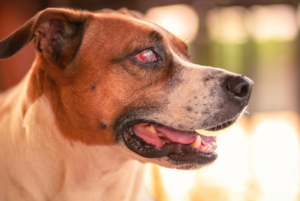
If you have a pug, you may notice a dark film slowly spreading across their eye. It can look subtle at first. But over time, it can affect your dog’s vision. This condition is called pigmentary keratitis, and in sunny places like Florida, it’s especially common.
So, What Is Pigmentary Keratitis?
Pigmentary keratitis happens when dark pigment builds up on the cornea (the clear surface of the eye).
Instead of staying clear, your pug’s eye may start to look:
- Brown or black in certain areas
- Hazy or cloudy
- Less reflective or “bright”
This pigment can gradually block light from entering the eye, impacting vision over time.¹
Why Pugs Are So Prone to It
Pugs are more likely to develop this condition because of the shape of their eyes.
A few key reasons:
- Large, prominent eyes that are more exposed
- Shallow eye sockets make it harder to fully protect the cornea
- Eyelid issues, like hair rubbing the eye
All of this creates chronic irritation, which triggers pigment to form as a protective response.²
How Florida’s Sun Can Make It Worse
If your furry friend lives in Florida, sunlight plays a bigger role than you might think.
- UV exposure increases eye irritation
- Bright light can worsen inflammation
- More time outdoors = more exposure
Over time, that added irritation can speed up pigment buildup on the eye.
Signs to Watch For
Pigmentary keratitis tends to develop gradually, so it’s easy to miss early on.
Keep an eye out for:
- Darkening of the eye
- Squinting or sensitivity to light
- Increased tearing
- Bumping into things
Can It Be Treated?
In short, yes. But while the pigment itself isn’t always reversible, the condition can be managed, especially if caught early. The goal is to slow or stop progression and protect your furry friend’s vision.³
Treatment may include:
- Lubricating eye drops to reduce irritation
- Medications to control inflammation
- Addressing underlying issues, like eyelid abnormalities
- Surgery in certain cases
If your furry friend’s eyes are starting to look darker or less clear, it’s worth having them checked.
References
- Gelatt KN, Gilger BC, Kern TJ. Diseases of the cornea and sclera. In: Veterinary Ophthalmology. 5th ed. Wiley-Blackwell; 2013.
- Bedford PG. Conditions of the canine cornea associated with brachycephalic conformation. J Small Anim Pract. 1980;21(11):617-629. doi:10.1111/j.1748-5827.1980.tb02534.x
- Labelle AL, Dresser CB. Pigmentary keratitis in pugs: prevalence and clinical characteristics. Vet Ophthalmol. 2013;16(1):54-60. doi:10.1111/j.1463-5224.2012.01017.x